Announcing RustFS 1.0.0 GA: Production-Ready, Open Source, S3-Compatible Object Storage
TL;DR: RustFS 1.0.0 GA is now generally available. Written in Rust and released under the Apache 2.0 license, RustFS has grown from its first commit in February 2024 into a distributed object storage platform with 32,000+ GitHub stars and 2.7 million+ instances deployed worldwide. The core object storage engine is stable and ready for production.
Today, we are excited to announce that RustFS 1.0.0 GA is officially available. From Alpha to Beta, RC, and now GA, the 1.0.0 release marks the moment RustFS is ready for production workloads.
RustFS is a next-generation distributed object storage system written in Rust. From the first line of code in February 2024 to today, the team has spent two years and seven months building and refining it. The 1.0.0 release means our core capability — object storage — is stable, and users can run it in production with confidence.
The Journey of RustFS
RustFS has come a long way from an empty editor window to a generally available platform:
| Date | Milestone |
|---|---|
| February 2024 | First line of code |
| July 2025 | Open sourced |
| October 2025 | 10,000+ GitHub stars |
| January 2026 | 20,000+ GitHub stars |
| April 2026 | Beta release |
| July 2026 | 30,000+ GitHub stars |
| August 2026 | RC release |
| September 2026 | GA release |
What RustFS Has Achieved
Since open sourcing in July 2025, RustFS has grown rapidly and reached a series of milestones:
- 32,000+ GitHub stars
- 10 million+ image pulls on Docker Hub
- 2.7 million+ instances deployed worldwide
- 160+ contributors across the globe
- Featured on GitHub Trending 9 times
- Featured on GitHub Rust Trending 50+ times
- Joined the NVIDIA Inception Program
RustFS 1.0.0 Core Features at a Glance
Data Management
- Full bucket lifecycle management
- Full object lifecycle management
- Multipart upload for large files
- Erasure coding (EC)
- Data tiering
- Lifecycle management
- S3 Tables — Apache Iceberg REST Catalog built into the storage kernel
Multi-Protocol Support
- Amazon S3-compatible API
- WebDAV
- Swift API
- FTP/FTPS
- MCP
Security & Compliance
- IAM
- OIDC
- KMS integration
- Server-side encryption (SSE)
- STS token service
- Security auditing
- mTLS
High Availability & Scalability
- Distributed deployment
- Pool expansion
- Data rebalancing
- Self-healing nodes
- Site replication / bucket replication
Operations & Observability
- Event notifications
- OpenTelemetry (OTEL) support
- Capacity statistics
- Cluster health inspection
- Multi-tenancy support
- Storage pool decommissioning
- Cloud-native support
Quick Start
RustFS supports multiple operating systems (Linux, Windows, macOS) and multiple installation methods, including source builds, binaries, Docker, and Kubernetes.
The fastest way to try RustFS 1.0.0 GA is with the official docker-compose.yml, which boots a RustFS instance inside a Docker container:
# Clone the repository
git clone git@github.com:rustfs/rustfs.git

# Start the container instance
cd rustfs
docker compose -f docker-compose-simple.yml up -d
Before running the command, change
RUSTFS_ACCESS_KEYandRUSTFS_SECRET_KEYto values other than the defaultrustfsadmin.
Then open http://ip:9001 in your browser to access the RustFS console:
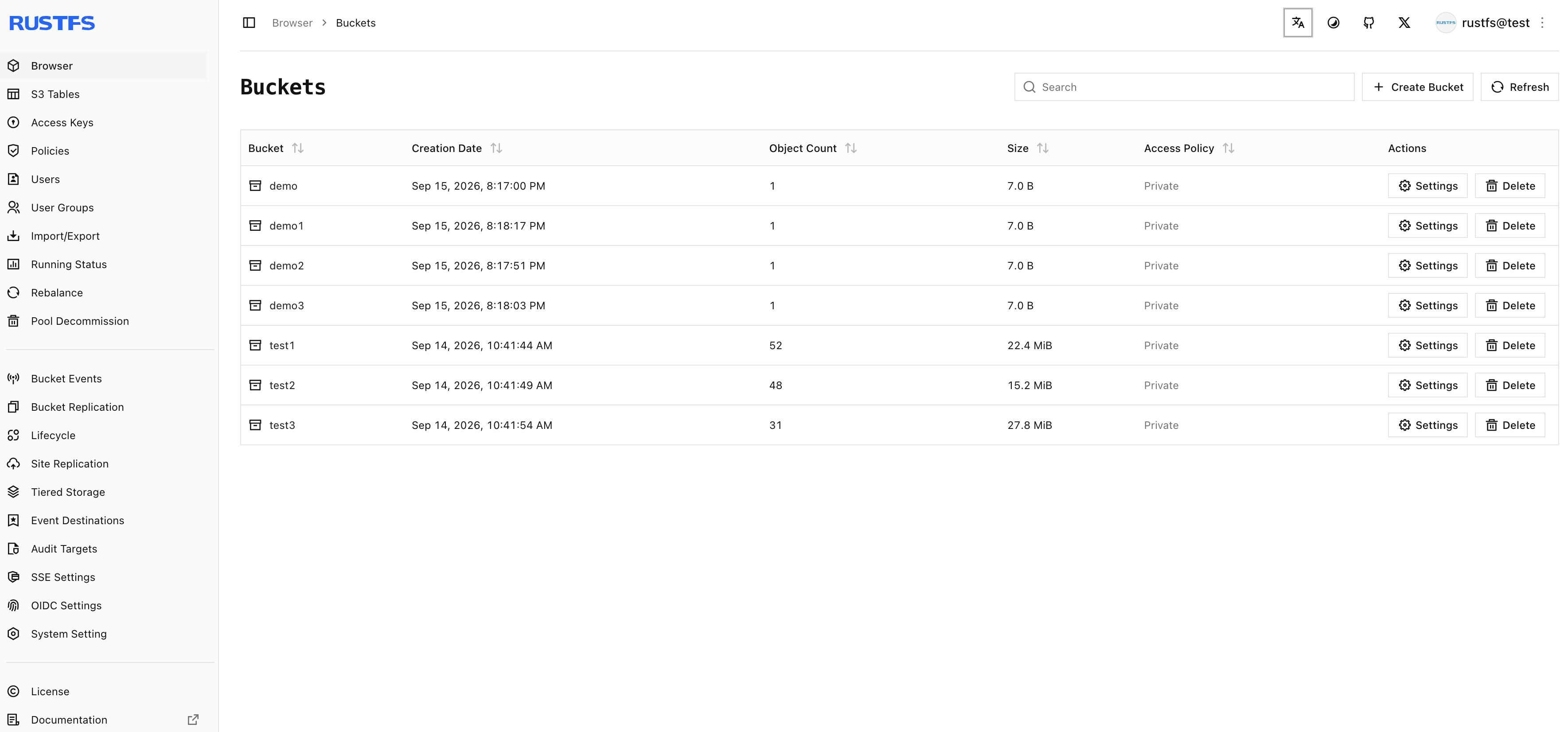
For more installation options, see the download page.
What's Next?
The 1.0.0 GA release is a major milestone for RustFS — and a new beginning. As more and more users run RustFS in production, our next steps are to:
- Actively respond to user and customer feedback and keep polishing RustFS to make it more robust
- Add support for S3 Vectors and build RustFS 2.0 around AI, bringing RustFS into AI data centers
If you have any questions, reach us through our website at https://rustfs.com or open an issue on the RustFS GitHub repository: https://github.com/rustfs/rustfs.