Erasure Coding Explained: How Reed-Solomon Keeps Data Safe When Drives Fail
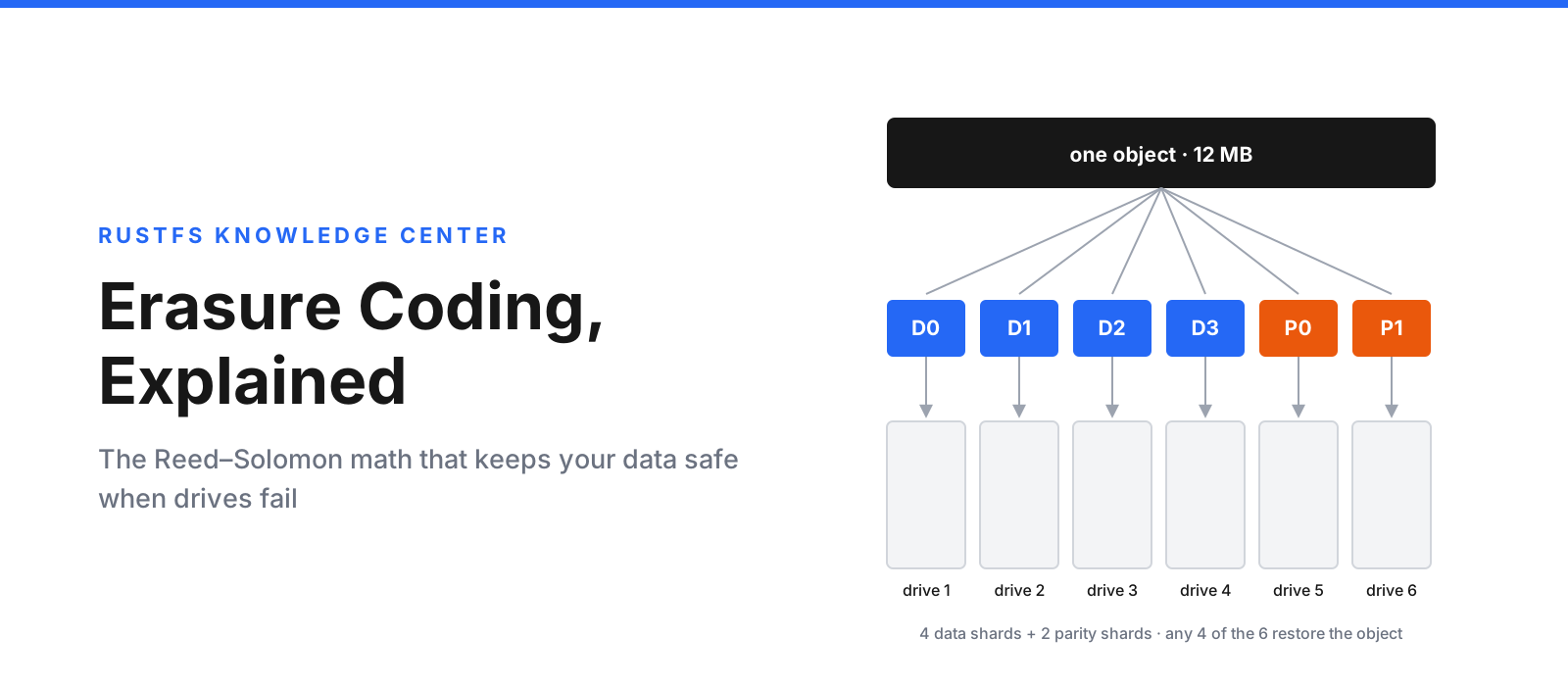
Drives fail. It is not a rare emergency — it is a statistical certainty. If you run a few hundred drives, one of them will die this quarter. If you run a hundred thousand, several will die today. The question every storage system must answer is not whether hardware fails, but what happens to your bytes when it does.
Erasure coding is the answer that object storage systems reach for: instead of keeping extra copies of your data, they compute redundancy — mathematically derived shards that can rebuild the originals if some pieces go missing. Used well, it survives multiple simultaneous drive failures at a fraction of the cost of replication.
This article walks the whole path: from the problem, through the algebra that makes erasure coding possible, down to how RustFS actually stores shards on disk — with the source code as our guide.
The naive answer: keep three copies
The simplest way to survive drive failure is replication: write every object to three drives instead of one. Any two drives can fail and the data survives. Replication is fast to read and trivial to reason about — but it costs 300% of your raw capacity to store 100% of your data.
Erasure coding reaches the same fault tolerance far more cheaply. A common layout stores 4 data shards plus 2 parity shards (written as EC:4+2): the data is split into four pieces, two extra "check" pieces are computed, and all six are spread across six drives. Any four of the six shards reconstruct the whole object. Two drives can fail — the same tolerance as three-way replication — at 150% raw overhead instead of 300%.
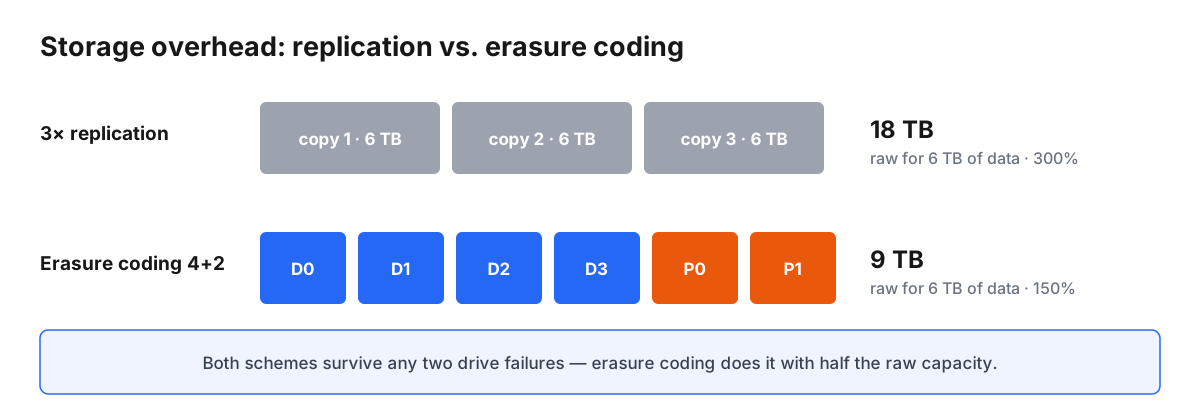
For petabyte-scale deployments, that difference is the entire business case. But how can six different pieces of data, none of which is a copy, recover an object? To answer that, we have to leave simple arithmetic behind.
Split, then compute: the shape of an erasure code
Every erasure code works in three steps:
- Split the object into
kequally sized data shards (this article uses 4+2 as our running example, sok = 4). - Compute
mparity shards from the data shards (herem = 2). Parity shards are pure redundancy — each one is a mathematical function of the data, not a copy of any of it. - Spread all
k + mshards so that no two shards of the same object share a drive.
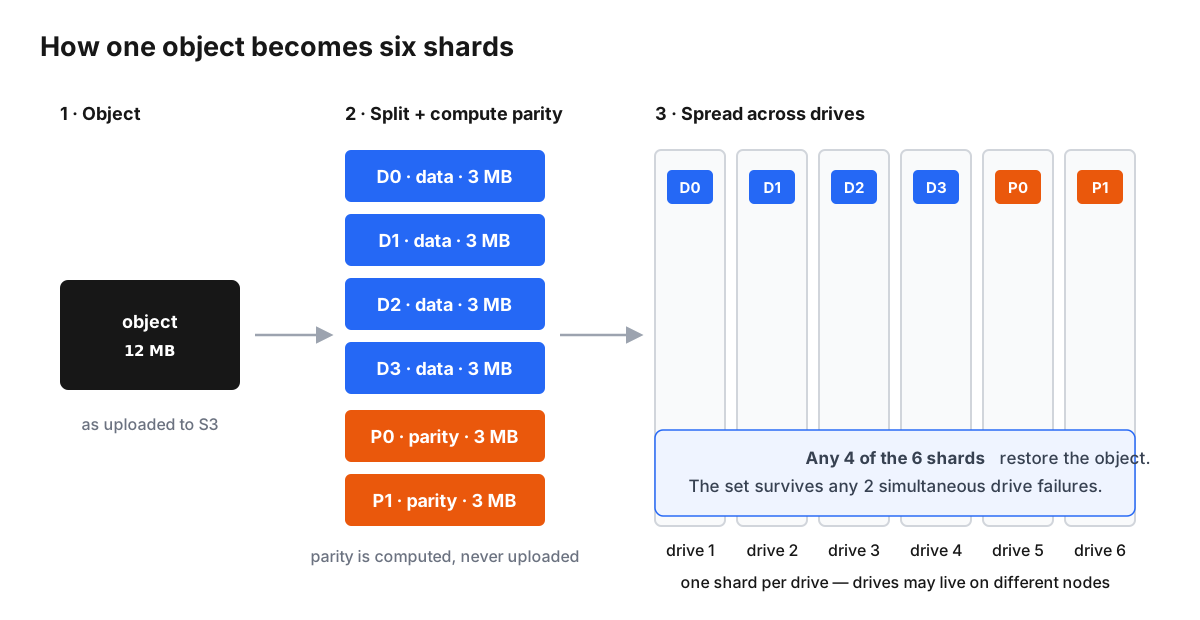
The magic property — the one every design decision serves — is that any k
of the k + m shards are sufficient to reconstruct everything. Lose one
shard? Five remain; any four rebuild it. Lose two? Four remain; still enough.
Lose three? Only three remain, and the object is gone. That gives the scheme
its tolerance: an EC:4+2 object survives any 2 simultaneous shard losses.
So the question becomes: what kind of math can turn 4 pieces into 6, such that any 4 of the 6 give the original back?
From XOR to Reed-Solomon
You already know one erasure code, even if you have never called it that. XOR.
In a RAID-5 array, a parity block is the XOR of all data blocks. If any one block is lost, XOR the survivors with the parity and the missing block reappears. But XOR parity has a hard ceiling: one equation, one unknown recovered. Lose two blocks and the single parity equation has two unknowns — unsolvable.
The conceptual leap of Reed-Solomon coding is to build m different parity
equations instead of one, with m different coefficient sets — and to do the
arithmetic in a number system where every equation is solvable. Ordinary
integer arithmetic does not work here: with fixed-width bytes, addition
overflows, subtraction needs borrows, and division is often impossible (there
is no integer x such that 3x = 1 mod 256... well, actually 171 works for
that one, but 2x = 1 mod 256 has no solution at all — even numbers never
produce odd results).
The fix is to replace integer arithmetic with finite field arithmetic.
GF(2^8): arithmetic on bytes without overflow
A finite field is a number system with the properties algebra needs — you can
add, subtract, multiply, and divide (except by zero) — but it wraps around a
finite set of values. For byte-oriented data the natural choice is GF(2^8): a
field of exactly 256 elements, one per byte value.
Its rules are unusual at first glance, and they are worth internalizing:
- Addition is XOR. No carries, no overflow.
0x57 ⊕ 0x83 = 0xD4, and that is the whole definition. A pleasant consequence: addition and subtraction are the same operation (a - b = a ⊕ b). - Multiplication is polynomial multiplication. Treat each byte as a
polynomial of degree 7 whose coefficients are bits, multiply the polynomials,
then reduce the result modulo a fixed primitive polynomial
x^8 + x^4 + x^3 + x^2 + 1(written0x11D). Reduction here is polynomial long division with XOR in place of subtraction — so again, no carries. - Every non-zero element has a multiplicative inverse. This is the property
integers mod 256 lack, and it is what makes matrix inversion — and therefore
recovery — always possible.
2x = 1has no solution mod 256, but in GF(2^8) every byte has a partner that multiplies to 1.
Under these rules, bytes stop being fragile quantities that overflow and start behaving like well-behaved algebra. And algebra is exactly what we need.
Encoding: one matrix multiplication
With GF(2^8) arithmetic in hand, Reed-Solomon encoding is compactly described
as matrix multiplication. Take the k data bytes at some position across
the data shards (one byte from each shard), arranged as a column vector
[d0, d1, d2, d3]. Multiply it by a generator matrix G with k + m rows and
k columns:
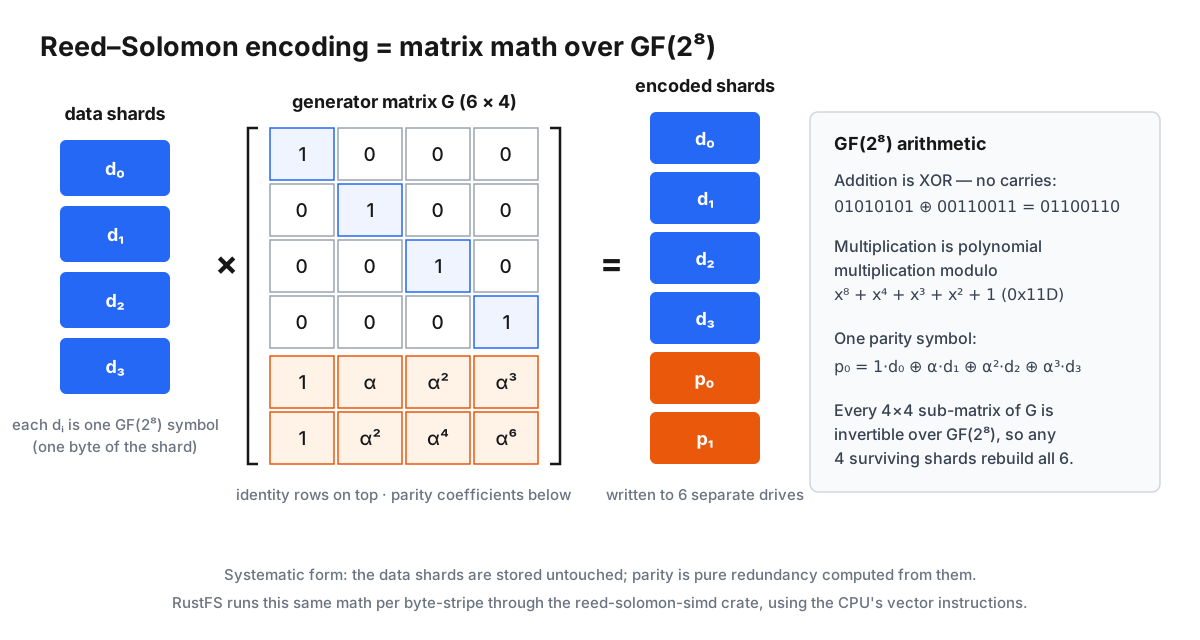
The top k rows form an identity matrix, which is a deliberate design choice
called systematic form: the data shards pass through unchanged, so reading
an intact object is just concatenation — no decoding required. The bottom m
rows hold the parity coefficients. Row i of a Vandermonde-style matrix
carries successive powers of a field element α, giving parity bytes like:
p0 = 1·d0 ⊕ α·d1 ⊕ α²·d2 ⊕ α³·d3
p1 = 1·d0 ⊕ α²·d1 ⊕ α⁴·d2 ⊕ α⁶·d3
Each row is a different linear combination of the data — m independent
equations rather than one. Because α is a generator of the field's
multiplicative group, the rows are guaranteed to be independent in exactly the
way recovery requires: every square k × k sub-matrix of G is
invertible.
In practice the multiplication is applied per byte-stripe: the shards are cut into matching byte positions (one symbol per byte), and each position is encoded independently. That is why encoding is cheap — it is one pass of XOR and table-driven GF multiplications per byte.
Decoding: invert the survivors
Recovery is the same mathematics run backwards. Suppose shards D1 and P0 are lost. Four shards survive — D0, D2, D3, and P1 — and any four are enough:
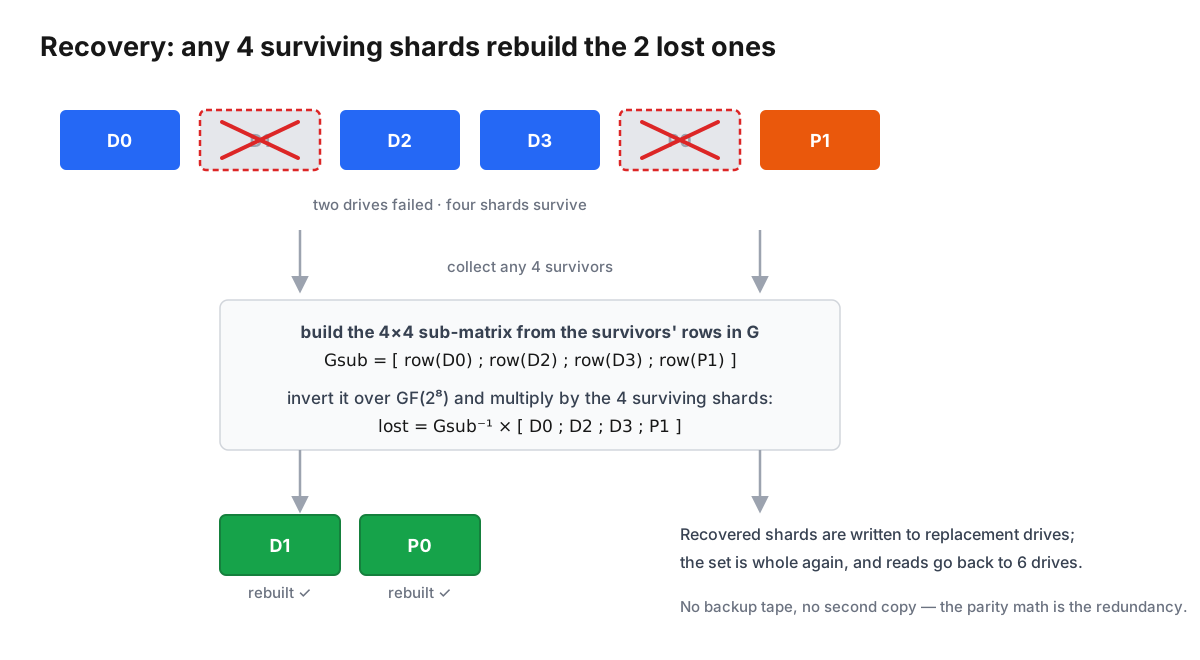
- Pick the 4 surviving shards and collect their corresponding rows from
G. - That
4 × 4sub-matrix is invertible (the property above). Compute its inverse over GF(2^8). - Multiply the inverse by the surviving shard values. Out come the original data bytes — including the bytes of the lost data shard D1.
- Re-encode parity to regenerate P0, and the set is whole again.
Note what this does not require: no second copy of the data, no backup, no rebuild from a remote replica. The redundancy is the parity math itself. This is also why erasure coding is sometimes described as "spare capacity converted into algebra."
Inside RustFS: theory meets disk
The mathematics above is textbook. What makes a storage system reliable is how faithfully — and how defensively — it implements the theory. Here is how RustFS does it (paths refer to the rustfs/rustfs repository).
Stripes and shards
RustFS erasure-codes objects in 1 MiB blocks, called stripes
(BLOCK_SIZE_V2 in crates/filemeta/src/fileinfo.rs). A 100 MiB object is 98
full stripes plus a short tail stripe; each stripe is split into k data
shards of ceil(stripe / k) bytes and m parity shards of the same size
(calc_shard_size in crates/ecstore/src/erasure/coding/erasure.rs). Working
in fixed stripes bounds memory use (a streaming write never holds the whole
object), makes partial reads efficient (a GET range touches only its stripes),
and keeps the codec's SIMD working set cache-friendly.
Choosing k and m: parity scales with the set
RustFS derives default parity from the number of drives in an erasure set
(default_parity_count in crates/ecstore/src/config/storageclass.rs):
| Drives per set | Default parity | Layout on a full set |
|---|---|---|
| 1 | 0 | no redundancy |
| 2–3 | 1 | EC:1+1 (2 drives) or EC:2+1 (3 drives) |
| 4–5 | 2 | EC:2+2 (4 drives) or EC:3+2 (5 drives) |
| 6–7 | 3 | EC:3+3 (6 drives) or EC:4+3 (7 drives) |
| 8+ | 4 | EC:4+4 (8 drives) up to EC:12+4 (16 drives) |
Two guardrails sit on top of this: parity can never exceed half the drives
(parity <= drives / 2) — which makes sense, since parity beyond the data
count buys little — and total shards per object must fit in GF(2^8), so at most
255 shards (MODERN_MAX_TOTAL_SHARDS). Erasure sets run from 2 to 16
drives. Operators can override everything via the RUSTFS_STORAGE_CLASS_*
environment variables (for example RUSTFS_STORAGE_CLASS_STANDARD=EC:3), and
the REDUCED_REDUNDANCY class deliberately trades durability for capacity at
EC:1.
Placement: which shard lands on which drive
Shard placement is not arbitrary. Each object gets a permutation derived
from the CRC32 hash of its bucket/object key (FileInfo::new in
crates/filemeta/src/fileinfo.rs): a rotation of shard indices starting at
hash % (k + m). Two consequences matter in production:
- Failure domains spread. Different objects put their shard 0 on different drives, so a single dead drive damages every object only slightly (one shard each) rather than destroying any one object completely.
- Sets stay balanced. The distribution recorded in the object metadata is a valid permutation by construction, and writes/reads shuffle disk order by it.
Two codecs, one contract
RustFS's erasure layer (crates/ecstore/src/erasure/coding/erasure.rs) runs
two Reed-Solomon implementations behind one interface:
- The modern codec —
rustfs-erasure-codec, a GF(2^8) implementation with SIMD acceleration — handles new writes. - A legacy codec — the
reed-solomon-simdcrate (the engine RustFS used in earlier versions) — remains in the read and heal paths for objects written in the old on-disk format (uses_legacy_checksumin the object metadata).
The two differ in an on-disk detail: legacy shard sizes are rounded up to an even number of bytes, while the modern formula uses plain ceiling division. Keeping both engines means old data is never stranded — a principle worth stating plainly: a storage system may evolve its codec, but it must never lose the ability to read what it wrote.
For speed, codec instances are cached per (k, m) pair, encoder workspaces are
reused across calls, and the hot path allocates a single buffer per stripe.
The cost is real but small: the codebase measures EC encode at roughly
110 µs per 1 MiB block (p99 around 542 µs) on its target hardware — a
few percent of what the network and disks spend moving those bytes.
Silent corruption: bitrot detection
Drive failures are loud — the drive disappears. Bit rot is quiet: sectors decay and serve plausible-looking garbage. An erasure code alone cannot catch this (corrupt bytes look like valid bytes), so RustFS protects every shard block with a checksum:
- On disk, each shard is a sequence of
[32-byte hash][data]frames (crates/ecstore/src/erasure/coding/bitrot.rs). The hash is HighwayHash-256 in streaming mode — fast enough to run on every read, with a fixed key (the HighwayHash of the first 100 decimals of π, for the curious). - Every read verifies each block's hash before the bytes reach the caller. A mismatch is treated as a corrupt shard — and then erasure coding does what it does best: the corrupt shard is simply discarded, and the object is reconstructed from the remaining shards. Corruption and failure converge on the same recovery path.
- RustFS additionally re-verifies freshly written shards after a PUT (write
self-verify) and supports per-stripe SHA-256 Merkle proof trees
(
shard-integrity-v1) for end-to-end verification.
Reads under failure
A healthy read is trivial: the k data shards concatenate back into the
object, no codec work needed. A degraded read is where the design shows:
- RustFS opens shard readers across the set's drives and reads just enough
shards —
ksuccesses per stripe — preferring data shards and engaging parity only when a data shard is missing or fails its checksum. Latency-wise, the firstkresponders win. - If fewer than
kshards can be read, the request fails with a read-quorum error — the honest answer that the object is temporarily (or permanently) unreadable. - When reconstruction is driven by suspect data, RustFS can verify the rebuild: it regenerates parity and byte-compares it against surviving parity shards, rejecting inconsistent sources rather than silently propagating corruption.
Healing: rebuilding what was lost
Failures are repaired by the heal path (Erasure::heal in
crates/ecstore/src/erasure/coding/heal.rs and the heal orchestration in
crates/ecstore/src/set_disk/ops/heal.rs):
- Read surviving shards stripe by stripe (each already hash-verified).
- Reconstruct data shards and regenerate parity from the same geometry used at write time — including the legacy codec for legacy-format objects.
- Stream rebuilt shards to replacement drives, with a deliberately lenient write quorum of 1 per target: a flaky replacement disk must not block recovery of the healthy ones. Progress is preserved block by block.
Because healing streams stripes — the same 1 MiB units used for writes and
reads — a rebuild of a 10 TB drive reads k × 10 TB across the survivors,
which is the operational cost of erasure coding: durability is bought with
rebuild I/O. This is exactly why parity is capped at half the set and why
cluster sizing counts rebuild bandwidth, not just steady-state throughput.
What erasure coding costs you
Erasure coding is not free, and honest documentation says so:
- CPU. Encoding and decoding are GF(2^8) math per byte. SIMD keeps this in the noise for sequential workloads (about 110 µs per MiB), but it is not zero, and small random writes feel it more than big sequential ones.
- Small objects. Splitting a 3 KB object into four shards is mostly overhead. RustFS mitigates this by inlining tiny shards into the object's metadata file (below the 128 KiB per-shard inline threshold), but for a workload of millions of tiny objects, replication can still be the better trade. Match the tool to the workload.
- Rebuild time. Restoring redundancy after a failure reads broadly across the surviving set. Larger sets and bigger parity make rebuilds longer — plan failure domains and spare capacity accordingly.
- Sub-matrix math on paper is free; in production it must also be correct. The edge cases — short tail stripes, zero-length objects, corrupted metadata, mixed codec generations — are where storage systems actually earn their reliability, and where RustFS's defensive checks (dimension validation, parity cross-checks, quorum rules) live.
Putting the math to work
Erasure coding is one of those ideas that is simple at the edges (split, add parity, survive failures) and deep at the center (finite fields, generator matrixes, invertible sub-matrixes). The payoff is durability that scales with math instead of with copies: EC:4+2 keeps data safe through two simultaneous drive failures at half the raw overhead of three-way replication.
If you are sizing a cluster, the erasure code calculator turns these trade-offs into concrete numbers for your drive count and object sizes. To see how the erasure layer shows up as a product capability — EC configuration, self-healing, and site replication in a running cluster — read the High Availability & Scale overview. And if you want the rest of the story — how objects land in erasure sets, how healing is scheduled, how S3 semantics ride on top — the RustFS documentation goes deeper, and the engineering blog covers the implementation as it evolves.